Esperanto lives on at AINekko

Esperanto Technologies was founded back in 2014, completed the RTL for their Maxion CPUs in September 2018, were doing bring-up and characterization of their ET-SoC-1 in H2 2021, and were happily outlining their next-gen ET-SoC-2x and ET-SoC-3x in November 2024. Unfortunately, things did not go to plan: they closed down in July 2025, retaining just a few people to facilitate selling or licensing their accumulated IP. The official line from the company is that competitors poached their staff with compensation packages up to 4x higher than what Esperanto could offer, and that slowly bleeding staff led to eventual death. Some voices in the media instead posit that the company failed on publicity and community engagement. Amongst other potential problems, their website (still) has an "I want to evaluate Esperanto systems" form, rather than an online store with prices and "Add to cart" / "Go to checkout" buttons. Being an AI chip startup is hard: you've got to get lots of things right, and just one of them being wrong is enough to condemn you to failure.

Fast-forward to the present day - October 2025 - and AINekko drops out of stealth, with two interesting repos on GitHub: et-platform and et-man. I don't know for sure, but it looks like AINekko purchased the ET-SoC-1 IP, and is proceeding to open it all up. et-platform contains a simulator, a kernel driver, and all sorts of firmware / bootcode / management software, all available under the Apache License v2. Meanwhile, et-man currently contains "just" a comprehensive programmer's reference manual, but it looks like more documentation should land there in due course. There's also a claim that the RTL will be open-sourced eventually, though I imagine that this will only be the RTL written by Esperanto, and not any 3rd-party IP they licensed to include in their chip (e.g. PCIe controllers from Synopsys). The et-platform README helpfully states:

AINekko's ET is an open-source manycore platform for parallel computing acceleration. It is built on the legacy of Esperanto Technologies ET-SoC-1 chip.

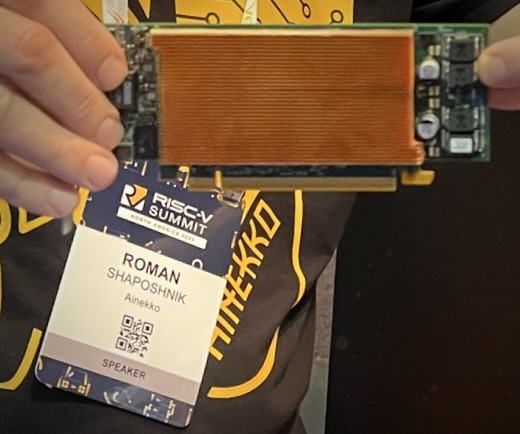
It lives on, but what exactly is this chip? There's a photo of AINekko's CTO holding one of the PCIe boards on X:

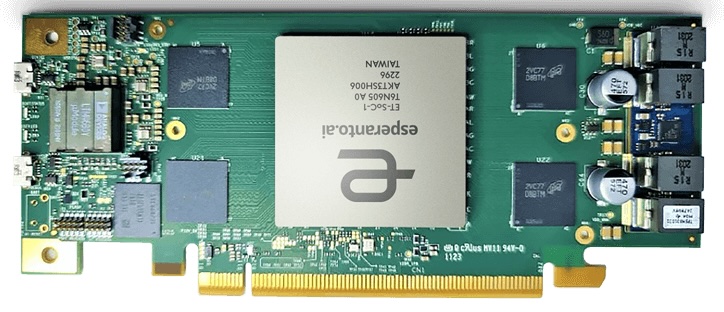
An image from the Esperanto product page shows what's under that heatsink:

Presumably it's a PCIe Gen4 x8 edge connector on the bottom, 32 GiB of LPDDR4x (the four ~square black chips), and an ET-SoC-1 in the middle. The ET-SoC-1 ASIC is itself a grid of tiles with a NoC mesh stop in each tile:

There are four different types of tile:

KindCountContents (per tile)
DRAM8Bridge to 4 GiB LPDDR4x (2 16-bit channels per tile)
PCIe1Bridge to host over PCIe
Maxions14x Maxion CPU core, 1x Minion-lite CPU core, 5 MiB SRAM
Minions34 (†)32x Minion CPU core (2 threads each), 4 MiB SRAM

(†) Documentation suggests that 1 of the 34 is lost for yield purposes, leaving 33 usable.

This grid is somewhat reminiscent of a Tenstorrent Wormhole or Blackhole, though with a major philosophical difference: the Tenstorrent approach is to have a separate address space per tile with software explicitly initiating asynchronous NoC transactions to move data around, whereas ET-SoC-1 adopts a more GPU-like approach with a single address space spanning the entire ASIC and a hierarchy of hardware L1 / L2 / L3 caches to mitigate latency. Another big difference at the NoC level is that Wormhole and Blackhole choose to go with two unidirectional toruses, whereas ET-SoC-1 has a single bidirectional grid.

The DRAM and PCIe tiles are relatively mundane, containing LPDDR4x controllers and PCIe controllers respectively. Neither has any programmable CPU cores, and they are mostly transparent to software: parts of the address space do physically live in these tiles, but software doesn't need to worry about the physical location of memory, as the NoC hides the details.

Next up, the Maxions tile is roughly similar to a Tenstorrent ARC tile combined with a SiFive x280 tile as found on Blackhole: each Maxion CPU core is a 64-bit RISC-V single-threaded superscalar out-of-order CPU core capable of running Linux, just like a SiFive x280, and the Minion-lite serves the same role as an ARC core with regards to board and system management. The 5 MiB SRAM in the tile is split as 1 MiB scratchpad for the Minion-lite and 4 MiB L2 for the Maxions (though the L2 can instead be reconfigured as scratchpad).

The majority of the ET-SoC-1 ASIC is made up of Minion tiles, similar to how the majority of a Tenstorrent ASIC is made up of Tensix tiles. Both contain low-power in-order RISCV cores, but the differences quickly become apparent. There is a lot to be said about these minions, but it'll have to wait until next time.

RISC-V Conditional Moves

I'm a big fan of aarch64's csel family of instructions. A single instruction can evaluate rd = cond ? rs1 : f(rs2), where cond is any condition code and f is any of f0(x) = x or f1(x) = x+1 or f2(x) = ~x or or f3(x) = -x. Want to convert a condition to a boolean? Use f1 with rs1 == rs2 == x0. Want to convert a condition to a mask? Use f2 with rs1 == rs2 == x0. Want to compute an absolute value? Use f3 with rs1 == rs2. It is pleasing that the composition of f1 and f2 is f3. I could continue espousing, but hopefully you get the idea.

RISC-V is the hot new thing, but it lacks a direct equivalent to csel. Some cases of converting conditions to booleans are possible with the slt family of instructions in the base instruction set. Beyond that, a few special cases are implemented by instruction set extensions: Zbb adds min and max instructions which are a particular pattern of compare and select, and Zicond adds czero.eqz and czero.nez which again are particular patterns of compare and select. But the general case? Considered and rejected, as per this direct quote from The RISC-V Instruction Set Manual Volume I Version 20250508:

We considered but did not include conditional moves or predicated instructions, which can effectively replace unpredictable short forward branches. Conditional moves are the simpler of the two, but are difficult to use ...

That quote hints at short forward branches being the recommended alternative. It doesn't quite go as far as to say that out-of-order cores are encouraged to perform macro fusion in the frontend to convert short forward branches back into conditional moves (when possible), but it is commonly taken to mean this, and some SiFive cores implement exactly this fusion.

Continuing to quote from The RISC-V Instruction Set Manual Volume I Version 20250508, the introductory text motivating Zicond also mentions fusion:

Using these [Zicond] instructions, branchless sequences can be implemented (typically in two-instruction sequences) without the need for instruction fusion, special provisions during the decoding of architectural instructions, or other microarchitectural provisions.

One of the shortcomings of RISC-V, compared to competing instruction set architectures, is the absence of conditional operations to support branchless code-generation: this includes conditional arithmetic, conditional select and conditional move operations. The design principles of RISC-V (e.g. the absence of an instruction-format that supports 3 source registers and an output register) make it unlikely that direct equivalents of the competing instructions will be introduced.

The design principles mentioned in passing mean that czero.eqz has slightly odd semantics. Assuming rd ≠ rs2, the intent is that these two instruction sequences compute the same thing:

Base instruction setWith Zicond
  mv rd, x0
  beq rs2, x0, skip_next
  mv rd, rs1
skip_next:
  czero.eqz rd, rs1, rs2


The whole premise of fusion is predicated on the idea that it is valid for a core to transform code similar to the branchy code on the left into code similar to the branch-free code on the right. I wish to cast doubt on this validity: it is true that the two instruction sequences compute the same thing, but details of the RISC-V memory consistency model mean that the two sequences are very much not equivalent, and therefore a core cannot blindly turn one into the other.

To see why, consider this example, again from The RISC-V Instruction Set Manual Volume I Version 20250508:

Control dependencies behave differently from address and data dependencies in the sense that a control dependency always extends to all instructions following the original target in program order.

  lw x1, 0(x2)
  bne x1, x0, next
next:
  sw x3, 0(x4)

Even though both branch outcomes have the same target, there is still a control dependency from the memory operation generated by the first instruction in this snippet to the memory operation generated by the last instruction. This definition of control dependency is subtly stronger than what might be seen in other contexts (e.g., C++), but it conforms with standard definitions of control dependencies in the literature.

The general point highlighted by this example is that every branch (or indirect jump) instruction imposes a syntactic control dependency on every store instruction anywhere after it in program order. If a branch is converted to a conditional move, there is no longer a syntactic control dependency. There can instead be an address or data dependency, but this only applies to stores which use the result of the conditional move, whereas the syntactic control dependency applied to all stores. In other words, not equivalent.

TLDR: If RISC-V cores want to perform fusion of short forward branches into conditional moves (to mitigate the lack of conditional moves in the instruction set), the resultant fused instruction needs to retain some branch-like properties to avoid violating the memory model.

Reworking Lengauer-Tarjan

In compiler circles, Lengauer & Tarjan's 1979 paper "A Fast Algorithm for Finding Dominators in a Flowgraph" is a classic: it describes and proves a viable algorithm for computing the idom of every node in a rooted directed graph. I have just two criticisms of the paper:

  1. All the sample code is written in Algol. This was a fine choice in 1979, but tastes have changed over the intervening 46 years, and most modern eyes will see the Algol code as somewhat antiquated.
  2. It starts by presenting an optimised variant of the algorithm, rather than starting with the most basic exposition and then introducing optimisations.

I believe that both problems can be addressed via a little bit of reworking.


The algorithm takes as input a graph G with some root node r. We immediately perform a depth first search on G; let T be the spanning tree discovered by that search, and replace all node labels with the pre-order index from that search. The root node is now 0, one of its successors is 1, and so forth. For arbitrary nodes v and w, this allows us to write things like v < w and v ≤ w and min(v, w), all of which are operating on these indices. We also introduce some notation for talking about these graphs:

NotationMeaning
v ->G wThere is an edge from v to w in G, and w != r
v -*->T wThere is a path from v to w in T, or v == w

We jump in at what the paper calls Theorem 4, which enables this definition:

sdom(w) = min({     v  |               v ->G w and v ≤ w} union
{sdom(u) | u -*->T v and v ->G w and v > w and u > w})

This definition is recursive, but only in the case of u > w, so we can compute it for all nodes by first computing it for w = N-1, then for w = N-2, and so forth until we eventually reach w = 1 (we cannot compute it for w = 0, as both sets are empty in that case).

Reworking Theorem 3 slightly enables this definition:

idomfrom(w) = argminu{sdom(u) | u -*->T w and u > sdom(w)}

Where argminu{expr | condition} gives the u which minimises expr (over all the possible u which meet condition), or any such u if there are multiple u achieving that minimum. Note that the set is always non-empty, as u = w meets the condition. As u -*->T w implies u ≤ w, we also have idomfrom(w) ≤ w.

Then reworking Theorem 2 slightly enables this definition:

idom(w) = sdom(w) if idomfrom(w) ≥ w else idom(idomfrom(w))

This definition is recursive, but only in the case of idomfrom(w) < w, so we can compute it for all nodes by first computing it for w = 1, then for w = 2, and so forth until eventually we reach w = N-1.

This gives us everything we need to compute idom, via a four step process:

  1. Perform a depth first search on G, to give T (and pre-order integer nodes).
  2. Compute sdom(w) for all w > 0, in decreasing order of w.
  3. Compute idomfrom(w) for all w > 0, in any order.
  4. Compute idom(w) for all w > 0, in increasing order of w.

In both steps 2 and 3, we're interested in either min or argminu over the set {sdom(u) | u -*->T v and u > limit}, for various values of v and limit. There are (at least) three different strategies for computing each of these min / argminu:

  1. From scratch every time: whenever such a computation is required, start with u = v, and then iterate u = parent(u) (where parent gives the parent in T) until u ≤ limit, taking the min / argminu of sdom(u) over all the observed u for which u > limit.
  2. Like strategy 1, but introduce a layer of caching to avoid repeated work. The paper calls this "path compression", which is one way of viewing it, but you reach the exact same place if you instead apply aggressive caching to strategy 1. For this to work, all queries need to be made in decreasing order of limit, as otherwise previously cached results wouldn't be valid. This happens naturally for step 2 (because it has limit = w, and is performed in decreasing order of w), but slightly more work is required to extend it to step 3: the usual approach is to chop up step 3 into lots of small pieces, and perform them interleaved with step 2 at appropriate times.
  3. Like strategy 2, but doing the union-find equivalent of "union by rank/size" rather than the union-find equivalent of "path compression". Note that the min and argminu operations in question aren't quite union-find, but they're sufficiently similar that the ideas can carry over.

These three strategies are in increasing order of implementation complexity, but also decreasing order of worst-case algorithmic complexity. Strategy 3 is best in theory, but the general consensus is that strategy 2 usually beats it in practice. Meanwhile, the Go compiler uses strategy 1 and considers it sufficient.

If using strategy 1, the pseudocode for steps 2 through 4 can be quite concise:

# Step 2
for w in range(N-1, 0, -1):
  sdom[w] = min(strategy1(v, w)[0] if v > w else v for v in pred(w))

# Step 3
for w in range(1, N):
  idomfrom[w] = strategy1(w, sdom[w])[1]

# Step 4
for w in range(1, N):
  idom[w] = sdom[w]           # Relevant  when idomfrom[w] = w
  idom[w] = idom[idomfrom[w]] # No change when idomfrom[w] = w

def strategy1(v, limit):
  us = [v]
  while parent(us[-1]) > limit: us.append(parent(us[-1]))
  return min((sdom[u], u) for u in us)

Note that pred in step 2 gives the predecessors in G, whereas parent in strategy1 gives the parent in T.

There are two little tricks to avoid some of the function calls in step 3:

  1. If sdom(w) == 0, then u = w is an acceptable result from argminu.
  2. If sdom(w) == parent(w), then u = w will be only possible argminu.

We can revise step 3 to detect these two cases, and handle them without a call:

# Step 3
for w in range(1, N):
  if sdom[w] in {0, parent(w)}:
    idomfrom[w] = w
  else:
    idomfrom[w] = strategy1(w, sdom[w])[1]

If we then want to use something better than strategy1, step 3 needs to be chopped up and interleaved with step 2. One way of doing this is to introduce an array called deferred, which is conceptually storing various sets: calls to strategy1 in step 3 are changed to instead add a node to a set, and then the actual calls happen later when the set is drained. The pseudocode for steps 2 and 3 thus becomes:

# Step 2 and Step 3
deferred = [0] * N # Initialise deferred (all sets empty)
for w in range(N-1, 0, -1):
  v = deferred[w]
  while v != 0: # Drain set
    idomfrom[v] = strategy1(v, w)[1]
    v = deferred[v]
  sdom[w] = min(strategy1(v, w)[0] if v > w else v for v in pred(w))
  if sdom[w] in {0, parent(w)}:
    idomfrom[w] = w
  else:
    # Add w to set, will drain when step 2 reaches sdom(w)
    deferred[w] = deferred[sdom[w]]
    deferred[sdom[w]] = w

Then we can upgrade steps 2 and 3 from strategy1 to strategy2:

# Step 2 and Step 3
deferred = [0] * N # Initialise deferred (all sets empty)
for w in range(N-1, 0, -1):
  v = deferred[w]
  while v != 0: # Drain set
    idomfrom[v] = strategy2(v, w)[1]
    v = deferred[v]
  sdom[w] = min(strategy2(v, w)[0] if v > w else v for v in pred(w))
  if sdom[w] in {0, parent(w)}:
    idomfrom[w] = w
  else:
    # Add w to set, will drain when step 2 reaches sdom(w)
    deferred[w] = deferred[sdom[w]]
    deferred[sdom[w]] = w
  cache_ancestor[w] = parent(w)
  cache_result[w] = (sdom(w), w)

def strategy2(v, limit):
  vs = []
  ancestor = cache_ancestor[v]
  while ancestor > limit:
    vs.append(v)
    v = ancestor
    ancestor = cache_ancestor[v]
  result = cache_result[v]
  while vs:
    v = vs.pop()
    result = min(result, cache_result[v])
    cache_result[v] = result
    cache_ancestor[v] = ancestor
  return result

I consider strategy2 to be sufficient, so I won't present a strategy3. Instead, a few memory optimisations are possible to anyone squeezing out performance:


Once idom(w) has been computed, it can be used to compute DF(w) in the style of Cytron et al's 1991 paper "Efficiently Computing Static Single Assignment Form and the Control Dependence Graph":

for w in bottom_up_traversal_of_dominator_tree:
  DF(w) = set()
  for v in succ(w): # successors in G
    if idom(v) != w:
      DF(w).add(v)
  for v in children(w): # children in the dominator tree
    for u in DF(v):
      if idom(u) != w:
        DF(w).add(u)

Alternatively, idom(w) can be used to compute DF(w) in the style of Cooper et al's 2001 paper "A Simple, Fast Dominance Algorithm":

for w in G:
  DF(w) = set()
for w in G:
  if len(pred(w)) ≥ 2: # predecessors in G
    for v in pred(w):  # predecessors in G
      u = v
      while u != idom(w):
        DF(u).add(w)
        u = idom(u)

Note that if len(pred(w)) ≥ 2: is an optimisation, rather than a requirement for correctness: when len(pred(w)) == 1, the sole predecessor of w will be idom(w), so the innermost loop won't execute.

This formulation is easily amenable to representing DF values as arrays rather than sets, as deduplication needs only to look at the most recently inserted value:

for w in G:
  DF(w) = []
for w in G:
  if len(pred(w)) ≥ 2: # predecessors in G
    for v in pred(w):  # predecessors in G
      u = v
      while u != idom(w):
        if len(DF(u)) == 0 or DF(u)[-1] != w: DF(u).append(w)
        u = idom(u)

Finally, once DF(w) is available for all w, SSA construction becomes simple: if G denotes a control flow graph of basic blocks, then for every variable assigned-to in w, DF(w) is exactly the set of basic blocks which require a phi function (or basic block argument) inserted at their start to reconverge the various assignments of that variable. A mere two caveats apply:

  1. The phi function is another assignment to the variable in question, which possibly enlarges the set of variables assigned-to by the basic block into which the phi was inserted. Multiple iterations can be required to reach a fixpoint.
  2. Some liveness analysis can be applied to avoid inserting phi functions whose result would never be used.

Tenstorrent Wormhole Series Part 8: Reference

This blog series (1, 2, 3, 4, 5, 6, 7) has given an introduction to Wormhole and a tour of some of its low-level functionality. If it has whetted your appetite, then the follow-up is the tt-isa-documentation repository I've been writing - it is the comprehensive reference manual going into detail on all the pieces. The reference manual bookends the blog series; there's no need for more blog parts, as the manual contains all the material I'd want to cover.

Tenstorrent Wormhole Series Part 7: Bits of the MatMul

Previously, in part 6, I took a deep dive into Tensix Vector, but if you're buying Tenstorrent hardware, you almost certainly want fast matrix multiplication. Furthermore, if that is your view, then everything else on the chip is secondary to matrix multiplication: SRAM and DRAM are for storing matrices close to the compute logic, Tensix Vector is for operating on matrix multiplication results without having to send them back to the host over PCIe, and so on.

Back in part 5, we saw one representation of a T tile, emphasizing the RISC-V cores. A different representation of the same thing instead emphasizes Tensix Matrix and the data paths to/from it:

The above diagram requires a few remarks:

The focus might be on Tensix Matrix, but the data path between Tensix Matrix and L1 goes through Tensix Unpack and Tensix Pack. The very quick summary of these units is that they can perform some light data type conversion and some light reshaping, but mainly just shovel data between L1 and SrcB / SrcA / Dst. The bidirectional arrow on the diagram between Tensix Pack and L1 is there because Tensix Pack can perform either L1 = Dst or L1 += Dst, with the latter eliminating some of the need for Tensix Unpack to write to Dst. Tensix Pack can also perform some flavors of ReLU, though only as L1 = ReLU(Dst) or L1 += ReLU(Dst), and not as L1 = ReLU(L1 + Dst).

The sub-32-bit types that Tensix Unpack can write to SrcA and SrcB include:

With that interlude complete, we can finally look at Tensix Matrix. It is capable of a few different operations, but the big one is matrix multiplication, doing Dst += SrcB @ SrcA, where Dst and SrcB are both 8x16 and SrcA is 16x16:

The TT-Metal API tends to expose 32x32 blocks, matmul for which can be built out of the 8x16 matmul, one possible arrangement being:

For the primitive 8x16 operation, what gets applied to each scalar element of Dst is d = d + a0·b0 + a1·b1 + ⋯ + a15·b15, where ai ranges over a column of SrcA and bi ranges over a row of SrcB. For a 32x32 block, the primitive 8x16 operation needs to be applied 16 times in total (because there are 8 chunks of Dst, and each chunk requires a 32-element dot product rather than just a 16-element dot product).

The scalar + and · in the previous paragraph are floating-point addition and multiplication. If you're not a hardware designer, you might view floating-point addition and multiplication as magical primitive operations provided by hardware. If you are a hardware designer, you'll know that nothing is magic: floating-point addition and multiplication need to eventually be implemented via a mixture of integer comparisons, shifts, additions, and multiplications. To really reinforce the point that nothing is magic, I can show you code for bf16 fused-multiply-add implemented using just integer operations. Any actual hardware would be described in (System)Verilog rather than C, but there are more people who can read C than Verilog. If you look through that code, you'll see a few major pieces:

  1. Decompose the bf16 inputs to their sign / exponent / mantissa (lines 20-21).
  2. For normal numbers, re-attach the implicit one bit at the top of the mantissa (line 21). For denormal numbers, use __builtin_clz and << to find and reposition their most significant one bit (lines 22-24).
  3. Check for any input being NaN or infinity, and return an appropriate NaN or infinity if so (lines 33-45).
  4. Perform the multiply: xor of signs, integer addition of exponents, integer multiplication of mantissas (lines 31, 47-49).
  5. Perform the addition: determine the largest exponent, use >> on the mantissa of the other value to equalize the exponents, then integer add or subtract the mantissas (lines 51-73).
  6. Turn the result back into bf16: __builtin_clz and << or >> to get exactly 10 bits of mantissa, clamp exponent to the range 0-255 (possibly another >> here if the value is denormal), then pack sign and exponent and mantissa into 16 bits (lines 75-85).
  7. Considering all the bits thrown away by >> in previous steps, perform rounding on the result (rounding to nearest, ties to even). This is just line 88, though it relies heavily on p_m <<= 3, z_m <<= 3 and on sticky_shift in earlier steps.

If you're aiming for full IEEE754 conformance, then all of the above steps are required. If instead you're designing hardware for AI, then any step that can be removed and/or simplified is a massive win: each Tensix Matrix unit on a Wormhole chip wants to perform 2048 floating-point multiplies and 2048 floating-point additions per cycle, and there are 80 Tensix Matrix units on each chip, so any cost savings in either multiplication or addition get amplified 16,3840 times. Even a small simplification becomes noticable when amplified that much. I don't know exactly what simplifications Tenstorrent have opted for, but there are potential savings in every step:

  1. Perform decomposition somewhere else (e.g. in Tensix Unpack rather than Tensix Matrix).
  2. Treat all denormals as zero, thus saving on __builtin_clz and <<.
  3. Correctly handle only some cases of inputs being NaN or infinity.
  4. Use only some of the mantissa for multiplication rather than all of it.
  5. If adding more than two values together, determine the largest exponent of all of them, then use >> to equalize all their exponents at once (some academic work calls this a Class IV multi-term adder). All the mantissas can then be added together using a multiple-input integer adder, rather than a tree of two-input adders.
  6. If the result is going to immediately feed into step 1 of another multiply/add, skip step 6 and the subsequent step 1. Additionally, if the result is denormal, treat it as zero to save on >>.
  7. Use a cheaper rounding mode: either rounding toward zero (no rounding bits required), or rounding to nearest with ties away from zero (just one rounding bit required).

Treating denormals as zero on input (step 2) and on output (step 6) are relatively common simplifications; usually even CPUs have options for it. The more unusual simplifications are in steps 4 and 5. For step 4, if you want to be able to multiply a variety of floating-point formats between bfp2 and tf32, then you'd normally need an 11b by 11b multiplier for this step:

That said, fp8 (e5m2) only requires 3b by 3b multiply, and bf16 only requires 8b by 8b, so the full 11b by 11b might feel wasteful if lower-precision operations the majority of your workload. The particular simplification that Tenstorrent have opted for in Wormhole is a 7b by 5b multiplier, which can be invoked up to four times to cover (almost) the full range:

This has a number of interesting implications:

At this point, we can cross-check with the advertised TFLOP/s numbers. We'd expect 4.096 TFLOP/s from each Tensix Matrix unit when LoFi is in use (e.g. for fp8), half that when LoFi + HiFi2 is in use (e.g. for bfp8), and half that again when all of LoFi + HiFi2 + HiFi3 + HiFi4 are required (e.g. for fp16). With 72 usable Tensix Matrix units on an n150s board and 128 usable on an n300s board, this would mean:

n150sn300s
Just LoFi, e.g. fp8 (e5m2)294.9 TFLOP/s524.3 TFLOP/s
LoFi+HiFi2, e.g. bfp8147.5 TFLOP/s262.1 TFLOP/s
LoFi+HiFi2+HiFi3+HiFi4, e.g. fp1673.7 TFLOP/s131.1 TFLOP/s

Meanwhile, the one-pager from the Tenstorrent sales page reports:

The bfp8 and fp16 numbers are exactly as expected. The oddity is the fp8 number, which is only 88.9% (i.e. sixteen eighteenths) of expected. This suggests that at such low precision, the bottleneck becomes data transfer (e.g. 16 cycles to multiply a 32x32 tile, but 18 cycles to get the data in or get the data out).

To hit these TFLOP/s numbers, "all" you have to do is write code for one of the RV "T" cores to issue a matrix multiplication instruction every cycle, and write code for the other four RV cores to keep data flowing in and out at the right rate. The Macro-Op Expander and Replay Expander seen in part 5 help with this task: the expanders can output a Tensix instruction every cycle without themselves needing to be instructed every cycle, giving the RV cores a bit of time to do other things (such as control flow). Then repeat this 72 times for an n150s board, or 128 times for an n300s board. In either case, that'll result in several hundred RV cores busily working away!

That wraps up part 7; there will likely be a long gap before the next part due to a certain factory game expansion pack being released next week.

page: 1 2 3 4